AI Data Centers: The Real Reason They're Going Up Everywhere
This piece argues that the explosive buildout of AI data centers isn't just about chatbots and cloud services — it's the physical infrastructure for surveillance, digital identity, and behavioral data systems converging on a deadline. Funded largely by retirement money through firms like BlackRock, these facilities are being fast-tracked into rural communities using the same playbook as the fracking boom, and the author lays out what people can actually do about it.
1. What an AI Data Center Actually Is
The author starts by cutting through the vagueness of the term "AI data center." It sounds like a server room — abstract, technical, somebody else's business. But that vagueness is doing work, they argue. You can't organize against something you can't picture.
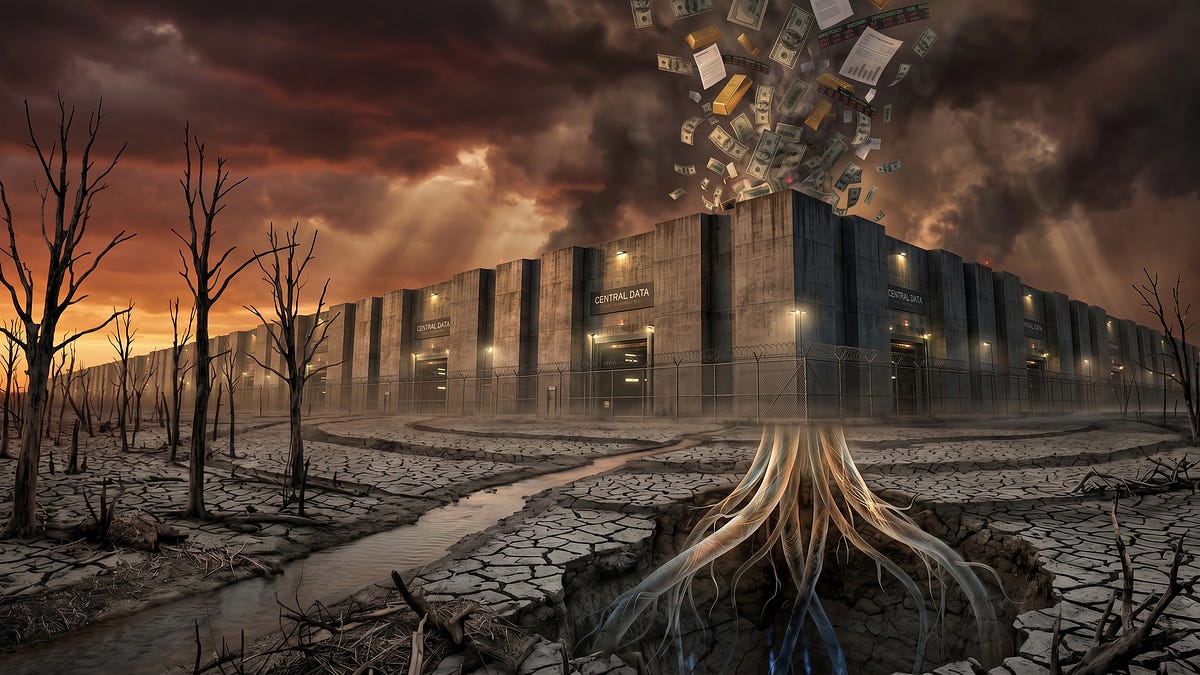
So here's the reality: these are massive industrial facilities, typically half a million to several million square feet. They house tens of thousands of specialized processors in dense racks, each rack drawing more power than an average home. A full center can consume 100 to over 1,000 megawatts — the largest rival the electricity use of a mid-sized city. Cooling all that heat requires water, sometimes millions of gallons a day, pulled from local aquifers, rivers, or municipal supply. The buildings are featureless — no windows, razor wire. A facility using a city's worth of electricity might employ only thirty to a hundred people. It exists to host computation, not workers.
The big question: what is all that computation actually for?
2. The Argument: Beyond Chatbots
The author is upfront about distinguishing documented facts from their own interpretation. The "boring," documented use of these buildings is commercial — training AI models, running cloud services. That's real. But the author makes a bolder case:
The strategic reason for a buildout this fast, this coordinated, and this heavily financed is bigger than chatbots — these facilities are becoming the physical substrate for surveillance, digital identity, and behavioral data systems, and the people funding them have said as much in public.
To illustrate, they point to a pattern you can verify yourself. The UN's 2030 Agenda Target 16.9 says "provide legal identity for all, including birth registration" by 2030 — clean, humanitarian language. The word "digital" doesn't appear there. It lives one layer down, in the World Bank's ID4D program, which explicitly states it's delivering that legal identity as digital identification systems.
The mandate is written in language no one can attack, and the machinery is built somewhere you have to go looking.
The author is careful to note they're not claiming the entire 2030 Agenda is a surveillance plot. Most of the seventeen goals are about poverty, water, health, and education. Their claim is narrower: one target inside it is the on-ramp for population-scale digital ID, and that deserves scrutiny.
The bigger thing to watch is convergence. Digital identity (UN/World Bank), central bank digital currencies (central banks and BIS), behavioral data systems (ad-tech and surveillance industry), smart-city programs — these come from different bodies, not one blueprint. What they share is that every one of them needs enormous compute to run at scale. The data centers are that compute. 🔗
3. The Pattern You Might Remember: Fracking
If you lived through the fracking boom of the late 2000s and 2010s, you've seen this script before. Fracking was sold to rural communities in Pennsylvania, Ohio, West Virginia, North Dakota, and Texas as salvation — jobs, tax revenue, energy independence. Outside companies signed leases, fast-tracked permits before community input could complete, drilled, extracted, and left. What stayed were the externalities: contaminated wells, methane migration, earthquakes, road damage on the local tax base, gutted property values. The jobs were mostly temporary. The tax revenue mostly got abated.
The data center buildout, the author argues, is the same playbook, different commodity. Same target communities — rural, semi-rural, eroded tax bases, thin local government. Same fast permits. Same outside money. Same promises. Same externalities about to land on the same people.
The fracking generation remembers. That memory is one of the few advantages this round of resistance has, and it won't last forever.
4. Who's Actually Paying 💰
Larry Fink runs BlackRock, the world's largest asset manager — $13.9 trillion under management as of Q1 2026. A significant portion is American retirement money: pensions, 401(k) allocations, target-date funds that auto-allocate wherever the managers point them.
In his April 2026 letter to investors, Fink argued AI leadership would require sustained, large-scale investment. At a BlackRock event in Waco, Texas, alongside Governor Greg Abbott, he predicted the money would come from trillions in "savings accounts and pension accounts." He estimated the buildout could total around $10 trillion over ten years.
He's telling you how it gets paid for.
BlackRock founded the AI Infrastructure Partnership (AIP) in September 2024 with Global Infrastructure Partners, MGX (an Abu Dhabi sovereign-wealth vehicle), Microsoft, and NVIDIA. In October 2025, AIP's first deal was the roughly $40 billion acquisition of Aligned Data Centers — the largest data-center transaction on record, targeting $30 billion in equity and up to $100 billion including debt. American retirement capital, pooled with Gulf sovereign wealth, building the AI backbone.
The author puts it bluntly:
If you hold a 401(k), an IRA, a pension, or any retirement vehicle run by a major asset manager, some portion of your money is likely funding this right now. You didn't consent to this specifically. You consented to "diversified investment." The managers decide what that means.
You're paying through retirement vehicles, tax dollars, utility bills as the grid is upgraded, and water bills as the aquifers draw down. Opting out means accepting financial damage most working people can't absorb.
That's not force in the obvious sense. It's force in the structural sense.
5. Newspeak: The Language Is the Architecture
Before diving deeper, the author pauses on language — arguing it's not a detour but the very architecture of how these systems gain acceptance.
Surveillance becomes data collection. Censorship becomes content moderation. Coercion becomes nudging. Dissent becomes misinformation. Forced reallocation becomes investment. Land grabs becomes development. Aquifer depletion becomes resource utilization.
Each inversion collapses the space where the accurate word used to live. By the time you reach for the word you need, the preferred one is the only one left.
The author traces this pattern through history. The Patriot Act expanded domestic surveillance. Weimar Germany used Reichsfeinde — enemies of the Reich. Stalin's USSR ran on "enemies of the people." Apartheid South Africa's Terrorism Act of 1967 defined terrorism broadly enough that organizing qualified — Nelson Mandela was officially designated a terrorist, and the U.S. kept him on a terrorism watch list until 2008.
The reframe is the prerequisite. When a system starts reclassifying citizens into the language of terrorism, the clampdown isn't theoretical — it's the next phase.
6. Why It's Happening This Fast ⏱️
The author's read: the speed isn't driven by organic market demand. AI consumer demand barely existed five years ago. The buildout is racing a timeline.
The financing and framing both point to a deadline — the 2030 Agenda set targets for 2030. The systems that depend on compute (digital ID first among them) matured faster than the physical infrastructure to carry them. Fink saying the U.S. is "not moving fast enough" reads less like a market comment and more like a project status update.
They're behind on a schedule they set, and the window for installing the infrastructure without resistance is closing.
The author acknowledges this is interpretation, not proven fact — but argues it fits the financing, public statements, and documented deadlines better than "everyone suddenly wanted chatbots."
7. The Historical Lock
The author draws a chilling historical parallel. IG Farben was the German chemical conglomerate that backed the Third Reich — synthetic fuel, synthetic rubber, the Zyklon B used in the camps, its own slave-labor facility at Auschwitz-Monowitz. After the war, the Allies broke it into Bayer, BASF, Hoechst, and Agfa. The names changed; the personnel, patents, and relationships largely survived. The cartel reconstituted within years of Nuremberg.
The financial and industrial scaffolding behind authoritarian projects rarely gets dismantled when the regime fails. It gets renamed, restructured, and reattached to whatever comes next.
8. The Apparatus Being Built
In mid-May 2026, Fink publicly raised the prospect of civilians using inexpensive drones to attack AI data centers, framing it as a security risk his firm is planning around. The author reads this carefully:
The most powerful asset manager in the world doesn't float hardware-store drones in public unless his security team has already war-gamed civilian resistance.
The author notes how short the distance is between "civilian security threat to critical infrastructure" and "domestic terrorism" in the policy language. Once that reclassification happens, force becomes automatic.
Set this beside the buildout of detention capacity. The One Big Beautiful Bill Act (H.R. 1), signed July 4, 2025, directed more than $75 billion to ICE over four years — including roughly $45 billion for new detention centers — expanding capacity from about 56,000 beds toward 100,000 or more. The stated target is immigration enforcement. But:
Detention infrastructure has no target-population filter built into it. Once it exists, it holds whoever the regime in power decides it holds. The bed doesn't know who's in it.
There's also a quieter move: the push for "data embassies" — arrangements treating data centers as quasi-sovereign territory, partially exempt from local jurisdiction. Saudi Arabia, Estonia, and others have floated versions; industry likes it.
On the First Amendment, the author observes:
Speech is still protected by the text. What's been thinned is the procedural protection around speech that touches what the regime defines as security. You can still say what you want. What changes is the category you become when you say it.
9. What the Buildout Is Actually For: The Thesis
Pulling it all together, the author states their thesis directly:
The data centers are the physical substrate that surveillance, digital ID, behavioral scoring, and predictive systems all run on. The reclassification of pushback as a security threat is the legal lever. The detention capacity is the physical one. The language operation is the cultural one. All three are being installed at once, and all three depend on the compute the data centers provide.
Not chatbots. The backbone of a control architecture planned in pieces by different bodies, now being installed in the open.
10. Where Resistance Is Working 💪
The framework has to land somewhere physical, and physical places still have laws — some not yet captured.
- Tucson, Arizona rejected Project Blue after sustained organizing
- Chesterfield County, Virginia has delayed builds through zoning
- Communities in Oregon and Arizona forced water-use disclosure that didn't exist before
- Utah passed legislation requiring large data centers to report water usage to the state engineer
- In Montana, where the author writes from, a decade of water-rights litigation has created legal "antibodies" that data centers will walk into
And the author makes a broader point about how enforcement pyramids collapse:
When Ceaușescu gave his final speech in Bucharest in December 1989, his own security stopped defending him and the crowd that always applauded started booing. The apparatus collapsed in a week. The pyramid doesn't get pushed over from outside. It collapses from the middle when the people inside stop believing what they're enforcing.
11. What You Can Actually Do
The author is clear this doesn't end with "call your senator" — that door is mostly closed. The open ones:
- Read what your retirement money is actually buying, and pull what you can out of target-date funds that auto-allocate into AI infrastructure indexes
- Show up to zoning meetings before the build is announced, not after — the fight is won or lost at the permit stage
- File public records requests on water-use agreements and tax-abatement deals while they're still being negotiated — once signed, they're nearly impossible to reverse
- Document everything — the case studies cited five years from now are being built right now by people taking notes
What won't work: petitions to BlackRock, appeals to the FTC, waiting for an administration to fix it.
The mechanism is engineered to be unreachable through those channels. Naming the dead ends saves your energy for where the leverage is.
12. The Project That Cannot Finish
The author ends on a note that's both sober and strangely hopeful. In nearly every case, authoritarian projects attempt the same impossible thing: freeze a complex society into a fixed configuration. None have managed to hold it.
- The thousand-year Reich lasted twelve years
- The Soviet system lasted seventy
- Mao's Cultural Revolution was unwound within a decade of his death
- The British Empire dissolved in two generations
Total control requires perfect coordination among the people implementing it — and they can't fully trust each other once they understand what total control means.
The Berlin Wall fell in 1989 with the Stasi holding files on a third of the East German population — the most comprehensive surveillance of its time. It didn't matter. The system collapsed in weeks once attention rerouted away from compliance.
The apparatus was a stage set. When the actors stopped performing, the set came down.
The author's final message is urgent but grounded:
The vault is being built in your county while your retirement pays for it. The fracking generation knew something was wrong but didn't have the framework. You do.
They don't need camps when they have cloud regions. They also don't get to keep them.
Final Thoughts
This is a dense, carefully sourced piece that weaves together infrastructure finance, historical precedent, and political analysis into a single argument: the AI data center buildout isn't primarily a tech story — it's an infrastructure story with political implications that deserve public scrutiny now, before the concrete is poured and the permits are signed. Whether you agree with the author's broader thesis about surveillance and control, the documented facts about who's paying, how fast it's happening, and what communities are losing are worth grappling with. The window for engagement — at zoning boards, in public records, in how your retirement money is allocated — is open, but narrowing. 🏗️
Need a summary like this?
Get instant summaries with Harvest