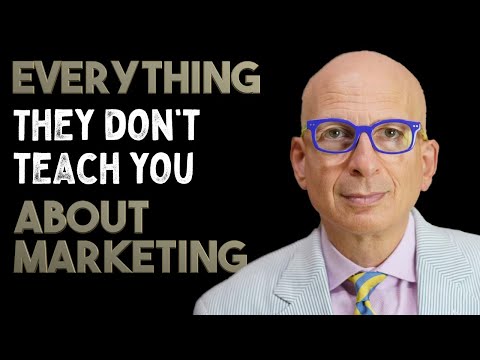
Seth Godin – Everything You (Probably) DON'T Know About Marketing
Brief Summary:
This video is a masterclass with Seth Godin, one of the leading voices in modern marketing, who shares fresh and practical insights from his book, "This Is Marketing." Godin demystifies the difference between brand and direct marketing, explores the power of culture and psychographics, and emphasizes focusing on meaningful work for audiences who truly care. If you want to rethink what marketing really is—and why it's not just about selling, but about making change that matters—this is the must-read summary for you.
1. The Real Value of Branding: More Than Just Logos
Seth Godin kicks things off with a fun but powerful observation on how companies—and people—obsess over their branding details, sometimes missing the bigger picture:
"Companies spend way too much time on their logo. Just like people on YouTube spend way too much time on their hair."
He illustrates this by asking us to imagine if major companies swapped industries:
"If Nike opened a hotel, we'd know exactly what it would be like. If Hyatt made sneakers, we'd have no clue."
The real difference? Nike has a brand—it stands for something clear and powerful—whereas Hyatt, despite being a giant, mostly just has a logo. A brand, Godin says, is a promise and a set of expectations. It's what we expect the next time we interact. If that expectation is clear and distinct, you've built something valuable.
But if your brand isn't distinct, you're just selling a commodity—competing entirely on price, like hotels that are only differentiated by cost online:
"The value of a brand is how much extra am I paying above the substitute? If I'm not paying extra, then you don't have a brand."
2. Rethinking Marketing: Making Change, Not Just Noise
Seth turns to clarify what marketing really is—and isn't:
"You have to begin by undoing the marketing of marketing. Marketing isn't selfish or a scam. It's not a short-term interruption thing. I'm telling you: you're a marketer and it's not an insult—it's a compliment. What marketers do is make change happen."
He explains that the first step is to ask, Who are you seeking to change, and what's it for? So many marketers try to sell "average stuff for average people," hoping sheer volume and noise will break through—but real success comes from focus and specificity.
A key point:
"The truly successful ones are specific. They're not general."
He introduces the idea that culture trumps everything else:
"If you've got culture at your back, what you're doing is easy. And if you're trying to change the culture, it's difficult."
A culture, to Seth, is summed up by:
"People like us do things like this."
Breaking this down: Who are your "people like us"? And what are the "things like this" they do?
3. Human Decision-Making: Status & Belonging
In perhaps one of his most eye-opening insights, Godin explains that human beings make decisions based on status—but not always in the obvious ways.
"Not the status of 'I have a fancier car than you'—well, that's part of it—but also who eats lunch first, who feels like they're moving up, and who feels left out."
Understanding these unspoken status games and the power of affiliation (wanting to belong) versus dominance (wanting to win) is at the heart of cultural influence and marketing success.
4. Brand Marketing vs. Direct Marketing: Core Differences
Time for some myth-busting! Seth draws a clear line between brand marketing and direct marketing—and this is a game-changer for people who confuse the two:
- Brand marketing is about building up a feeling and a story over time; it's difficult (and often impossible) to measure its impact right away.
- Direct marketing is all about measurement: you track who clicked, who bought, and change tactics fast.
He lays it out bluntly:
"You can't measure a brand. You must measure direct marketing. If you can measure it, you're going to act differently because you can see what happened Tuesday and change what you do on Wednesday."
Direct marketing—think Google and Facebook ads—lives and dies by click rates and immediate ROI. Brand marketing is harder to pin down but often much deeper and longer-lasting.
Seth also warns:
"If it does nothing but optimize, sooner or later, direct marketing on the internet races to the bottom because you're just trying to get a few clicks from a few people."
His rallying cry is simple:
"We need to race to the top."
So the best marketers know when to use each approach—and don't mix up the metrics!
5. Case Study: Nike, Kaepernick, and Risky Brand Moves
Godin discusses the headline-making Nike campaign featuring Colin Kaepernick—a true example of an established brand standing for something:
"At the level Nike is playing now, the number of ways that they can stand for something—anything—is very small. And here, with just a few words, they were able to say: us, him—we stand for something."
He notes that only certain brands could even dare to pull off a move like this. Authenticity matters:
"It wasn't a stunt. People who knew Nike said, 'Of course, it was very natural for them to do that.'"
Nike's audience—early adopters and cultural leaders—wanted their brand to stand up for something more. So, the campaign worked because it came from their "DNA," and because, psychographically, it spoke directly to their core group.
6. Demographic vs. Psychographic Marketing
Once upon a time, marketing was all about demographics—age, income, where you live, etc. But the internet (especially Facebook and Google) changed everything by allowing marketers to target based on psychographics:
"This is for people who like that. This is for people who believe this. Those are psychographics."
It's not about what you look like, but what you believe, feel, and dream.
Seth is clear:
"Going forward, the old-school marketer who still talks about demographics is wasting their time."
He emphasizes: Don't separate people by who their parents are or what zip code they live in. Separate them by what they believe and dream.
7. Finding & Serving Your Audience: The Power of Empathy
Godin wants marketers—all marketers, no matter their field or scale—to start with empathy:
"I don't think you have any business being a marketer unless you have empathy for the people you are seeking to serve."
Empathy means truly understanding your audience—not assuming they want what you want, but seeing the world through their eyes. The best place to begin, says Seth, is often with people like yourself, but you must be able to reach beyond that if you want to be a professional marketer:
"You don't have to be a woman to make pantyhose. You just have to be empathic."
He encourages not to over-focus on focus groups:
"People don't know what they want. They just know what they dream."
8. Mission-Driven Companies & Work That Matters
Seth turns to the rise of mission-driven or purpose-driven companies, like TOMS Shoes and Warby Parker, but makes clear it's not just about charity:
"You are seeking to make a change. The people who aren't those people, you're not trying to change them. You have a mission—the medium could change, but your mission would be consistent."
He warns against coming up with a fake mission as an afterthought, just to make money. Instead, real brand power comes from being genuine about the people you want to serve and how you want to change the world, even in small ways.
9. The Smallest Viable Audience and Focused Growth
Many believe growth is always better, but Seth disagrees:
"Don't level up on staff, don't level up on spend. Put all of it into better, not more, because if you can make better and afford to make better because you have true fans, maybe they'll tell their friends and maybe you can do this work."
His guiding principle is to focus on the smallest viable audience—not trying to please everyone, but delighting the people who truly care.
"Everyone is not the goal—cannot be the goal."
He shares his own journey: building programs and writing books not for the biggest numbers, but for people who really value his work. True fulfillment, he says, comes from serving that core group well.
10. Guiding Principles for Marketers: Start with the Truth
Seth wraps up with advice on navigating your own path:
"You've got to tell yourself the truth...Don't use other people's metrics to do your work. That's as bad as having a boss."
He encourages everyone to get clear about their own mission and audience. Some companies want to serve a mass market (like Starbucks making America drink better coffee), while others serve a select few (a great New York coffee shop for coffee lovers). Both are valid—as long as you stay true to your vision.
The biggest mistake? Compromising your values and losing what made you special for the sake of growth.
11. Creating Scarcity and Real Value
Seth shares some of his own book publishing tactics, like creating limited edition covers and adding unique value. He explains the power of scarcity:
"Scarcity creates value. But what it does for me as the Creator is to let me off the hook from infinity."
Trying to please everyone is a trap—meaning comes from focusing energy on a specific group, not the mass market.
12. Personal Reflections and The Drive to Teach
When asked about his next dream, Seth is candid, grateful, and passionate:
"For someone who's lucky enough to be able to do almost anything he wants, this is what I want to do. I want to be a teacher. I want to be somebody who helps turn on lights."
He sums up his motivation beautifully:
"It's always in the service—how do I make this place I'd rather live with my kids than it was yesterday?"
For Seth, being able to do work that truly matters, for people who value it, is the privilege of a lifetime.
Wrapping Up
This interview with Seth Godin delivers far more than marketing tricks—it's a blueprint for doing meaningful work that matters to the right people. He urges us to ditch the focus on mass appeal and empty metrics and instead build brands, businesses, and projects with real substance and empathy. The future of marketing isn't about shouting louder; it's about serving with purpose, earning trust, and making the culture you wish to see, one true fan at a time.
"We're not victims. We're creators."
✨ If you only remember one thing: Find your people, serve them well, be brave enough to stand for something, and make marketing the generous act it was always meant to be.
Need a summary like this?
Get instant summaries with Harvest