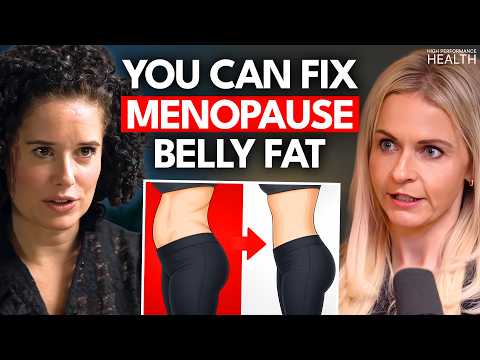
Why You're Gaining Belly Fat in Menopause (And What Actually Helps) | Dr. Sarah Berry
Professor Sarah Berry explains how the menopause transition dramatically shifts women's cardiometabolic health — from fat redistribution and blood sugar dysregulation to cholesterol changes — and shares practical, evidence-based strategies including fiber diversity, smart snacking, eating speed, and meal timing that can meaningfully reduce cardiovascular risk during midlife.
1. What Changes in Women's Cardiometabolic Health During Menopause
The conversation opens with host Angela Foster asking Professor Sarah Berry — a Professor of Nutritional Sciences at King's College London and Chief Scientist at ZOE — what actually changes in women's bodies as they transition through perimenopause and into postmenopause.
Sarah explains that cardiometabolic health encompasses blood pressure, cholesterol, inflammation levels, and body fat distribution, particularly visceral adiposity (fat around your organs and belly). Her research, along with extensive published literature, shows this is a massive period of change for women.
The good news? Before menopause, women actually have a metabolic advantage over men:
"Premenopause, women are doing really well compared to men. We have lower blood pressure, lower cholesterol, lower levels of inflammation, a better distribution of our body fat."
But then everything flips:
"Soon as you hit peri and postmenopause, suddenly it all changes. Blood pressure goes up, cholesterol levels go up, inflammation goes up, and your fat distribution changes."
Women go from a pear shape (fat around the hips) to an apple shape (fat around the belly). All of this traces back to the loss of estrogen, which acts on nearly every cell in the body and plays a huge role in where fat gets deposited, how food is metabolized, and how cholesterol and inflammation are regulated.
Angela asks about the timing — does this belly fat redistribution happen early in perimenopause or closer to the actual menopausal transition? Sarah's data shows it begins quite early during what she vividly describes as a period of hormonal chaos:
"You don't have this beautiful smooth reduction in estrogen. You have what I always call this state of hormonal chaos where you've got these peaks and these troughs."
During this chaotic phase, fat starts redirecting toward the belly. And this belly fat isn't just cosmetically frustrating — it's metabolically more active in a harmful way, stimulating inflammation far more than fat stored around the hips. Published data shows that the risk of abdominal obesity can increase two-fold during peri and postmenopause. 😮
2. Does Hormone Therapy Protect Against Visceral Fat and Cholesterol Changes?
Angela naturally asks whether women on menopause hormone therapy (MHT) are protected from these visceral fat gains. Sarah is honest that the evidence here is mixed but leaning positive.
"Some studies show that hormone replacement therapy or menopause hormone therapy is protective. Some studies show that it's protective for multiple cardiometabolic factors — be it blood pressure, be it cholesterol, be it the abdominal obesity. Other studies show less consistently that it is."
Her own research, published about three years ago in roughly 600 women, found that those taking some form of hormone therapy did show protection across many cardiometabolic health outcomes. However, she's careful to note:
"I don't think that the totality of the evidence is 100% consistent on this. But I do think that the majority of the evidence is supportive to this protective role."
This is a great example of Sarah's scientific integrity — presenting what the data shows while acknowledging where certainty ends.
3. Do Soy Isoflavones Help? The Gut Microbiome Factor 🦠
The conversation shifts to whether dietary approaches, particularly soy isoflavones, can support estrogen levels and reduce symptoms. Sarah explains that most research on menopause supplements has focused on symptom relief rather than specifically tracking cardiometabolic changes through the transition.
What she does know is that general dietary principles apply broadly — what's good for a male is typically good for a female at any age. Reducing saturated fat lowers blood cholesterol; increasing polyunsaturated fat does too. These fundamentals hold across ages and sexes.
But when it comes to symptom management, things get fascinatingly personalized. Soy isoflavones contain phytoestrogens — plant compounds that mimic estrogen by binding to estrogen receptors. The catch? How well they work depends entirely on your gut microbiome.
Some people have specific gut microbes that can convert soy phytoestrogens into a highly active compound called equol, which binds even more strongly to estrogen receptors. Sarah shares a striking statistic:
"If you have these species that enable you to produce equol, you have a 75% greater reduction in menopause symptoms if you supplement yourself with soy isoflavones compared to someone who doesn't have the same gut species."
This explains the classic scenario at the school gate:
"I could start taking soy isoflavones, my friend could take exactly the same. We could do everything else the same. But it might be that she's one of the lucky ones that's able to produce equol from those soy isoflavones and is feeling great and dancing down the street. Meanwhile, I'm still in bed crying over not sleeping last night with brain fog."
Can You Test for Equol Production?
Unfortunately, there's no commercially available consumer test yet. The complexity goes beyond just having the right bacterial species — it's also about whether those bugs are functionally active. For now, it's trial and error: try soy isoflavones and see if they help.
Interestingly, East Asian populations have a much higher prevalence of equol producers, which may partly explain why menopause symptoms appear less common in those countries — they consume more soy regularly and their gut microbiomes appear better equipped to convert it.
If you want to try supplementing, Sarah recommends looking for supplements rich in genistein (a specific soy isoflavone) at around 50 milligrams. While she always advocates a food-first approach, she acknowledges that getting the threshold dose (~15mg of genistein) from a typical Western diet alone can be quite difficult.
4. How to Improve Your Gut Microbiome Through Diet
Sarah outlines the key strategies for building a healthier microbiome, which benefits everything from symptom management to metabolic health:
Fiber, Fiber, Fiber 🌾
"95% of us in the UK, in the US, and many countries in Europe don't get enough fiber. Only about 5% of us get even the recommended amount."
She's enthusiastic about the emerging trend of "fiber maxing" and believes we're finally seeing a shift away from the protein obsession of recent years. But it's not just about total fiber — diversity matters too:
"Different gut bugs feed on different types of fibers."
The goal is to get fiber from a wide range of minimally processed plants: whole grains, nuts, seeds, lentils, pulses, fruits, and vegetables.
Polyphenols 🫐
Polyphenols are bioactive chemicals found in plant foods that dramatically improve microbiome composition. They're concentrated in:
- Colorful fruits: raspberries, blackberries, blueberries
- Unexpected sources: tea, coffee, cocoa (dark chocolate with lots of cocoa solids)
These compounds give fruits their color and bitterness — and they're incredibly beneficial for gut health.
The Coffee Bug ☕
Sarah shares a delightful finding from ZOE's research in 350,000 people: they discovered a specific gut bug that predicts with 100% certainty whether someone is a coffee drinker.
"If you have that gut bug, we can say with 100% certainty that you are a coffee drinker."
And if you stop drinking coffee, that bug simply dies away — a powerful illustration of how diet literally shapes the microbial ecosystem inside us.
What to Minimize
To make room for all these microbiome-friendly foods, try to limit heavily processed foods: processed red meats, white rice, white pasta, and refined grains.
5. Why Belly Fat Increases in Perimenopause — The Vicious Cycle of Estrogen, Hunger, and Blood Sugar
Angela raises a crucial chicken-and-egg question: visceral fat promotes insulin resistance, but insulin resistance also drives more visceral fat storage. So what's actually the starting point?
Sarah acknowledges this is genuinely hard to untangle:
"It's a bit like the chicken and egg. We don't know which comes first."
She explains the bidirectional relationship: visceral fat releases hormones that promote insulin resistance, and insulin resistance disrupts how we metabolize food and process cholesterol, which in turn promotes more weight gain. It's a circular process.
The Overlooked Symptoms
But beyond the biology, Sarah emphasizes something often forgotten — the psychological and behavioral burden of menopause:
"Although we typically talk about hot flushes, actually the most prevalent symptoms are anxiety, mood swings, depression, brain fog, poor sleep."
"If you're feeling pretty damn fed up and you're not sleeping, how motivated are you to eat well? How motivated are you to do physical activity?"
About 85% of women report poor sleep. Around 80% report anxiety, depression, or low mood. These symptoms indirectly worsen metabolic health by undermining the motivation to exercise and eat well.
The Blood Sugar Problem 📈
Sarah's research from the ZOE PREDICT studies reveals something striking. They gave roughly 600 women — pre and postmenopausal — exactly the same high-carbohydrate breakfast. The postmenopausal women had a significantly higher blood sugar spike from the identical meal.
To rule out age as the confounding factor, they matched pre and postmenopausal women of the same age. The result held:
"Dependent on not your age but your menopause status, there was this poorer metabolic response to consuming carbohydrates in postmenopausal women compared to premenopausal women."
These larger blood sugar spikes lead to bigger glucose dips 2-4 hours later, which trigger more hunger. Their research shows that people who experience these dips consume approximately 320 extra calories per day — setting off a metabolic roller coaster.
A Call for Self-Compassion 💛
Sarah makes an impassioned plea for women to be kinder to themselves during this transition:
"As a 49-year-old woman, when I see these pictures of Jennifer Lopez, Halle Berry, with their most perfect washboard belly and perfect figures, it can be hard to think, wow, how can I live up to that?"
"I can't because I have kids. I have jobs. And also, I want to enjoy my life. I want to enjoy my food. I don't want to be on a treadmill all day long and only eating carrot sticks."
She stresses that while staying physically active and eating well is crucial, women need to recognize that nature is genuinely working against them during this phase — and beating yourself up about it isn't helpful.
6. Saturated Fat Explained — Butter vs. Yogurt and the Food Matrix
The conversation turns to one of the most confusing areas of nutrition: what actually raises cholesterol and inflammation?
Sarah starts with the fundamentals: saturated fat has strong evidence showing it increases LDL ("bad") cholesterol, promotes inflammatory pathways, and raises cardiovascular disease risk. But she adds crucial nuance through the concept of the food matrix — the idea that the structure and nutrient interactions within a food alter how a given nutrient affects health.
The most striking example? Dairy:
"Saturated fat that's in unfermented dairy — butter for example — very clearly is associated with an increase in LDL cholesterol and an increased risk of cardiovascular disease. However, fermented dairy — yogurt and cheese — actually is not associated with an increase in cholesterol."
The same amount of saturated fat behaves differently depending on whether it comes from butter or from cheese/yogurt, likely due to something that happens during fermentation. This explains why some influencers can technically cherry-pick data from yogurt studies and claim saturated fat is harmless:
"If they're taking the data from yogurt, they're absolutely right. But if you again look at the totality of the evidence, populations consuming more saturated fat have higher LDL cholesterol, have higher risk of cardiovascular disease."
Saturated fat from tropical oils (coconut oil, palm oil) and from unfermented dairy (butter) clearly raises LDL cholesterol. Individual responses vary — a recent study from the University of Reading showed some people experience huge LDL reductions when cutting saturated fat, while others barely respond — but reducing saturated fat remains a strong starting point.
7. Do Seed Oils Cause Inflammation? The Scientific Evidence 🔬
This is the topic that earned Sarah the tongue-in-cheek title of "the most hated woman in America" 😄. She revisits the seed oil debate with characteristic thoroughness.
"The unfavorable effect of seed oils because of their high polyunsaturated fat, particularly their omega-6 fat, is actually not supported by evidence in humans."
The evidence she cites is substantial:
- More than 40 randomized controlled trials (the gold standard) show that seed oils / omega-6 polyunsaturated fatty acids do not increase inflammation across a whole host of inflammatory measures — and most studies show they may actually reduce inflammation
- They reduce LDL cholesterol
- They reduce cardiovascular disease risk
- A large JAMA study in hundreds of thousands of Americans found that those with higher seed oil intake had significantly lower rates of all-cause mortality, cardiovascular disease, and other diseases
"If you cherry-pick out studies that are done in a petri dish or in mice at super physiological doses under really unrealistic conditions, yes, you could find the odd study that shows that seed oils have a detrimental effect. But not in humans based on current evidence."
The Sydney Heart Study Myth
The commonly cited Sydney Heart Study (1966) — where men who increased polyunsaturated fat intake had higher death rates — gets a thorough debunking. Sarah explains that in the 1960s-70s, seed oils were primarily consumed as margarine spreads produced through partial hydrogenation, which created large amounts of trans fats.
"It was the trans fats that would actually give the solid attribute to the spread."
Trans fats are genuinely terrible for health — they massively increase inflammation, LDL cholesterol, and cardiovascular disease risk. But partial hydrogenation is no longer used in food production. Today's seed oils don't contain trans fats.
"Yes, there is truth to that story from the food that we were consuming 60 years ago, but absolutely not now."
What About the Refinement Process?
On the concern about hexane and other chemicals used in oil refining, Sarah explains that what remains in finished seed oils is trace or non-measurable. Critically, the clinical trials showing beneficial effects used refined seed oils, not cold-pressed ones. The refinement process actually removes impurities, makes the oil more stable, extends shelf life, and reduces oxidation — it's designed to improve the product for human consumption.
"This argument that it's bad for you because it's refined — it doesn't hold out in human clinical trials."
8. What Is ApoB? The Cholesterol Marker Linked to Heart Disease ❤️
Angela asks about ApoB (Apolipoprotein B), an increasingly discussed cardiovascular risk marker. Sarah provides a clear explanation:
When we eat fat, it enters our blood — but fat isn't water-soluble (think of butter globules floating in water). So the body packages fats and cholesterol into specialized lipoprotein particles for transport. These particles get "address labels" that direct them where to go.
ApoB is essentially the delivery stamp placed on particles carrying dietary fat and liver-produced cholesterol (including LDL). Think of it as a universal tag on all the potentially harmful lipid particles circulating in your blood.
"What ApoB does is give us a more global measure of harmful blood lipids."
If your ApoB is high, you likely have elevated levels of both LDL cholesterol and triglycerides — and these particles are what's called atherogenic, meaning they promote the buildup of plaque (atherosclerosis) in artery walls.
While specialists can go even deeper — examining LDL particle sizes, density, and various intermediate lipoproteins — for most people, the practical takeaway is straightforward:
"Is your LDL cholesterol high? Is your ApoB high? If it is, yes, let's do something about it. Let's increase our polyunsaturated fat intake. Let's reduce our saturated fat intake. Let's increase our fiber intake, particularly soluble fiber."
Beta-glucan from oats, for example, has a potent role in reducing cholesterol levels.
9. Eating Speed, Late-Night Meals, and Metabolic Health in Midlife 🕐
Sarah pivots to something she finds particularly exciting: not just what we eat, but how we eat. Sometimes these behavioral changes are easier to implement than overhauling your entire diet.
Slow Down Your Eating
"If you can just slow down the rate at which you eat your food by 20%, you can subconsciously without even realizing it reduce your calorie intake by 15%."
Most people already know if they're a fast eater — you're the one who finishes while everyone else is still halfway through their plate. Simply slowing down is one of the easiest interventions available.
Stop Eating After 9 PM
There's really consistent evidence that eating late at night negatively impacts metabolic health. It's especially important during the menopause transition. Plus:
"The more calories you eat later in the day, actually the more hungry you wake up the next day."
Give Yourself a 12-14 Hour Overnight Fast
A fasting window of 12-14 hours overnight benefits the gut microbiome and metabolic health — even if it doesn't lead to weight loss per se:
"It's not just about weight. What we know is that for those people who are eating in a 10 or 12 hour window, so giving themselves a rest overnight, giving all of their cells a rest, that they tend to have better metabolic health."
Consistency Is Key 🔄
One of Sarah's most fascinating insights is about consistency — both in sleep and eating patterns.
Social jet lag — the difference in your sleep timing between weekdays and weekends — is associated with poorer metabolic health and less favorable microbiome composition. Similarly, erratic eating patterns (eating very little one day, then having five or six snacks the next) appear to be worse than consistent patterns:
"The evidence shows our body likes consistency."
If you're a snacker, that's fine — keep snacking consistently. If you're not, don't start randomly snacking some days. The key message is that your body thrives on predictable rhythms.
10. Almonds vs. Processed Snacks — The Study Predicting 30% Lower Heart Risk 🥜
Sarah saves one of her most powerful findings for last. In the UK and US, 25% of total calorie intake comes from snacks — that's a quarter of everything we eat. And snacks represent a unique opportunity because they're generally under our individual control, unlike meals that are often dictated by family, work, or social settings.
Her team at King's College London ran a clinical trial where participants were randomly assigned to either continue eating typical UK/US snacks or switch to almonds. After just six weeks:
"The improvement in LDL cholesterol and blood vessel function when people were having healthy snacks — nuts instead of the typical UK/US snacks — was so high it equated to a predicted 30% reduction in cardiovascular disease risk."
The participants changed nothing else about their diet or lifestyle. Just swapping snacks made that much difference.
Sarah's final practical challenge to listeners:
"If there's one thing that your listeners do today, it could be slow down how fast you eat your meal tonight, and tomorrow think a little bit more carefully if you are a snacker about what kind of snacks that you have, because you can significantly improve your health by doing both of those two things."
On the practical reality of eating late due to busy schedules with kids and activities, Sarah keeps it real — there's no magic formula. Batch cooking, leftovers, and eating with your children earlier when possible all help. But she also insists:
"If you're having a lovely time out with friends and you're still eating at 10:00, don't sweat it. It's not going to make a big difference."
And when it comes to not knowing everything, she models scientific humility beautifully:
"Don't trust the person that says they know everything."
Wrapping Up
Professor Sarah Berry delivers a masterclass in menopause metabolic health that's both scientifically rigorous and deeply compassionate. The core takeaways: estrogen loss during perimenopause triggers a cascade of metabolic changes — belly fat redistribution, higher blood sugar spikes, increased cholesterol, and greater inflammation — all compounded by the psychological burden of poor sleep, anxiety, and brain fog. But the actionable strategies are refreshingly simple: diversify your fiber sources, eat more polyphenols, swap processed snacks for nuts, slow down your eating speed, maintain consistent sleep and meal patterns, and stop eating by 9 PM. Perhaps most importantly, be kind to yourself — nature is genuinely working against women during this transition, and self-compassion isn't weakness, it's wisdom. 💜
Need a summary like this?
Get instant summaries with Harvest