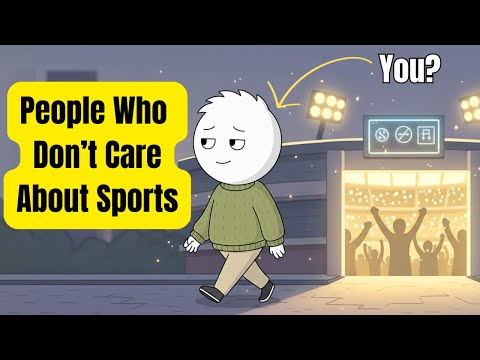
Psychology of People Who Don't Obsess Over Sports
This video explores why some people feel completely indifferent toward sports while others build their entire identity around it. By examining neuroscience, personality traits, and psychological frameworks, it reveals that non-sports fans aren't broken or boring—they're simply wired differently, finding meaning and emotional fulfillment through alternative channels.
1. The Tribal Brain: Why Sports Fandom Runs So Deep 🧠
The video opens with a striking contrast—while millions of people are screaming at their TVs, painting their faces, and becoming emotionally destroyed over games played by strangers, there's a massive group of people who simply don't care. And according to neuroscience, their brains might actually be wired differently.
"Not caring about sports doesn't make you boring. It doesn't mean you lack passion. And it definitely doesn't mean something's wrong with you."
But what is happening in the brains of those who obsess over sports? The answer goes back thousands of years. Humans are tribal creatures. Being part of a group meant survival—your tribe protected you from predators, helped you hunt, and kept you alive. Sports are essentially modern tribes with better merchandise! 🏈
When someone watches their team play, their brain releases oxytocin, the bonding hormone—the same chemical that makes you love your family.
"Their brain literally tricks them into thinking these millionaire athletes are part of their clan."
2. Lower Tribal Instincts: The Psychology of Sports Indifference
Here's where things get interesting. People who don't obsess over sports often have what psychologists call lower tribal instincts. Their identity isn't as strongly tied to group membership—they're more individualistic.
"I don't need to belong to something bigger to feel complete."
Research supports this. A 2019 study found that people with low sports interest showed significantly less "us versus them" thinking. In other words, they don't automatically hate the opposing team just because it's not "theirs."
This doesn't make them cold or disconnected—it simply means their sense of identity and belonging comes from different sources.
3. The Dopamine Game: Why Sports Watching Is Literally Addictive 🎰
The video dives into some fascinating (and slightly concerning) neuroscience about what happens in a sports fanatic's brain during a game.
You know that feeling when you're about to open a present? That anticipation? That's dopamine firing in your brain. Sports fans get that same hit during games—every play, every possession—constant micro-doses of anticipation and reward.
"It's literally addictive."
Studies using fMRI scans show that watching your team activates the same reward centers as gambling. The key ingredient? Uncertainty.
"You don't know if your team will win. That unpredictability keeps the dopamine flowing. It's intermittent reinforcement, the most addictive reward schedule known to psychology. The same principle that makes slot machines so effective."
The mechanism is eerily similar to other forms of behavioral addiction. Your brain doesn't distinguish much between different sources of dopamine—it just knows it wants more.
But here's the twist: People who don't care about sports? Their dopamine systems simply aren't triggered by vicarious competition. And this might be genetic. Research from the University of Chicago suggests that variations in dopamine receptor genes can predict how much someone cares about competitive spectator activities.
"Your complete indifference to whether the Lakers win or lose might literally be in your DNA."
4. BIRGing and Self-Esteem: The Pronoun Switch 🔄
Sports fans experience something called BIRGing—Basking in Reflected Glory. Pay attention to the language:
- When their team wins: "We won."
- When their team loses: "They lost."
Notice the pronoun switch? This is a form of psychological distancing—attaching yourself to victories and detaching from defeats.
People who don't obsess over sports are less likely to engage in this behavior. They're more consistent in their self-concept.
"They don't need external victories to feel successful. Their self-esteem is more stable, less dependent on things completely outside their control."
The video makes clear this isn't about one approach being better than the other—it's simply about understanding the legitimate psychological differences between these groups.
5. Empathy Allocation: Where Do You Direct Your Caring? 💭
Here's something that sounds contradictory: Sports fans often score higher on certain empathy measures. They practice caring deeply about other people's struggles—even if those people are strangers wearing their team's jersey.
So why don't non-sports people feel that same empathy for athletes? It comes down to empathy allocation.
"Everyone has a limited capacity for caring deeply about things."
Non-sports fans often direct that empathy toward different places:
- Social causes
- Personal relationships
- Creative projects
- Intellectual challenges
A 2021 study found that people with low sports interest scored much higher in openness to experience and appreciation for art and beauty. They're getting their emotional highs from art, music, nature, and ideas.
"Their brains are seeking the same reward—meaning, connection, transcendence. They're just finding it somewhere else."
6. The Defense Mechanism Factor 🛡️
The video gets honest about another dimension: for some people, not caring about sports is actually a defense mechanism.
Maybe they were bullied in gym class. Maybe they felt excluded by sports culture. Maybe they're pushing back against the aggressive competitiveness often tied to sports fandom.
"Maybe they just never understood why grown adults scream at televisions over a ball."
Your indifference might have a backstory. Or maybe you just find it boring. Both are completely valid!
7. Two Different Approaches to Meaning 📖
This section explains so much about why sports fans and non-sports fans sometimes can't understand each other. It comes down to how you experience meaning.
Sports fans find meaning in narrative:
- The underdog story
- The comeback
- The dynasty
- The rivalry
"It's compelling because it's unpredictable. Real life drama with genuine stakes."
Non-sports people often find that randomness meaningless:
"Why would I emotionally invest in an outcome I can't control, performed by people I don't know, in a game that doesn't affect my actual life?"
The video emphasizes that neither perspective is wrong—they're just two different approaches to the human need for story and meaning.
"One group finds epic narrative in a championship run. The other finds it in a novel, a relationship, a creative project, a scientific discovery."
8. Parasocial Investment vs. Direct Engagement 🎭
Researchers distinguish between parasocial investment and direct engagement:
- Sports fans build one-sided relationships with teams and players
- Non-sports people prefer investing emotional energy where there's actual reciprocity—where their care matters to the outcome, where they're participants, not spectators
"Neither is superior. They're just different strategies for navigating the human experience."
The video references psychologist Mihaly Csikszentmihalyi (creator of flow theory), who studied optimal experiences. He found that flow states—those moments of complete absorption—can be achieved through countless activities. For some, it's watching sports. For others, it's literally anything else.
Here's a particularly striking observation:
"People who don't obsess over sports often report feeling more present in their own lives. They're not spending 3 hours every Sunday experiencing someone else's struggle. They're engaged in their own. There's something quietly radical about that."
Wrapping Up: You're Just Playing a Different Game 🎯
The video closes with a powerful message of validation. If you don't care about sports, you're not missing out on some fundamental human experience—you're just different.
Your brain's reward system, your tribal instincts, your empathy allocation—they're all calibrated differently. And that's perfectly okay.
"The next time someone asks, 'Did you see the game?' and you genuinely could not care less—remember, you're not broken. You're not boring. You're just playing a different game. One that might, just maybe, have higher stakes."
Whether you're a die-hard fan or someone who's never understood the appeal, this video reminds us that both paths are valid expressions of the human search for meaning, connection, and belonging. 🙌
Need a summary like this?
Get instant summaries with Harvest