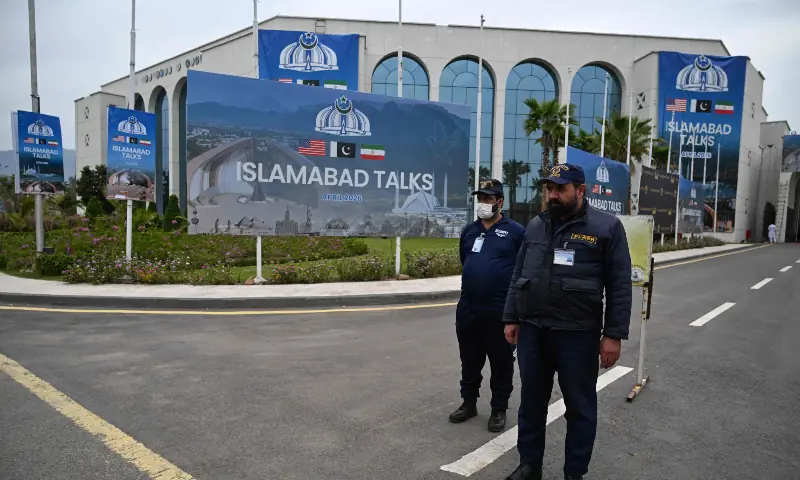
Islamabad Keyed Up for 'Make-or-Break' US-Iran Talks
In a historic diplomatic moment in April 2026, Pakistan is hosting the first direct, high-level talks between the United States and Iran since 1979. These highly anticipated negotiations aim to establish a durable peace and resolve complex nuclear and regional disputes, overcoming last-minute hurdles involving Israeli military actions in Lebanon. While expectations for an immediate breakthrough remain cautious, this meeting represents a rare and critical opportunity to de-escalate massive tensions in the Middle East.
1. Setting the Stage for Historic Talks 🤝
The highly anticipated dialogue between the United States and Iran is officially kicking off today in Islamabad. This marks a monumental moment in global diplomacy, as it is the first time since 1979 that Washington and Tehran are engaging in direct, high-level negotiations.
The Iranian delegation, led by Parliament Speaker Bagher Ghalibaf and Foreign Minister Abbas Araghchi, touched down early Saturday morning. They were warmly received by a team of top Pakistani officials, including the Deputy Prime Minister and the Chief of Defence Forces. Meanwhile, the American team, headed by US Vice President JD Vance and featuring top officials from the National Security Council and the Pentagon, was scheduled to arrive shortly after.
Pakistan has played a massive role in making this happen through intense backchannel diplomacy. Pakistani Prime Minister Shehbaz Sharif delivered a televised speech emphasizing the gravity of the moment, noting that the peace process is now entering a critical stage.
He described the process as entering a "difficult phase" and warned it was a "make-or-break situation", as efforts shifted from a temporary pause to a more durable settlement.
2. Navigating the Lebanon Hurdle 🛑
Just before the talks were set to begin, the entire process came dangerously close to falling apart. The major sticking point was Lebanon. Within the first 24 hours of an initial US-Iran ceasefire understanding, Israel launched over 100 deadly strikes in Lebanon.
Because of this, Iran firmly stated it would not participate in the Islamabad talks unless the Israeli strikes stopped. Iranian Parliament Speaker Mr. Ghalibaf laid out two strict conditions: an immediate ceasefire in Lebanon and the unfreezing of about $7 billion in Iranian assets held abroad.
He said these steps "must be fulfilled before negotiations begin".
Thanks to tireless backchannel communications involving Islamabad, Tehran, Washington, and other global players, a partial compromise was reached. Israel agreed to hold back its strikes in the specific areas of Beirut and its Dahieh suburb, which met Iran's core demand. However, it is worth noting that Israeli attacks tragically continued in other parts of southern Lebanon, claiming at least 23 lives.
To highlight just how fragile this compromise is, an Iranian official shared a very firm stance:
"We forced a pause in attacks in Beirut and Dahieh by making it a red line in negotiations and also made it clear that if Israel crosses it again, talks would be off."
3. Stances from Washington and Tehran 🇺🇸🇮🇷
Both sides are entering these talks with vastly different perspectives on the current ceasefire. Iran believes that any truce needs to cover all fronts, including their allied groups like Hezbollah in Lebanon. On the flip side, the US and Israel have essentially treated the attacks in Lebanon as a separate issue outside the main ceasefire agreement. This fundamental disagreement has constantly threatened to derail the peace efforts.
Before leaving Washington, US Vice President JD Vance expressed a sense of cautious optimism. He mentioned that the expected talks could be "positive" and assured that the US was coming to the table in good faith. However, he also issued a stern warning that the US would not be "receptive" to any attempts by Iran to intentionally stall the process.
US President Donald Trump took a much harder stance. He warned that Iran was running out of options and firmly stated that military action could easily resume if these talks fail. He also heavily criticized Iran for placing restrictions on commercial ships passing through the Strait of Hormuz—a crucial global shipping route that Iran is using as leverage in this standoff.
4. The Complex Agenda Ahead 📋
Prime Minister Shehbaz Sharif expressed immense gratitude to both nations for accepting his proposal to meet in Islamabad. He promised that Pakistan would "try its level best" to ensure the talks succeed, framing this as a golden chance to resolve "contentious issues through dialogue."
However, the actual agenda on the table is incredibly complex. The discussions are primarily built around a 10-point proposal from Iran, which the US has accepted as a basic framework. But the actual demands from each side are worlds apart:
- What the US wants: Strict restrictions on Iran's nuclear program. This includes putting limits on nuclear enrichment (the process used to create nuclear energy or, at higher levels, nuclear weapons) and potentially removing existing nuclear materials from the country.
- What Iran wants: Complete relief from economic sanctions, official recognition of their right to nuclear technology, access to their frozen international funds, and a clear framework for navigating the Strait of Hormuz.
On top of all this, they also have to tackle heated issues regarding Iran's missile capabilities and regional proxy networks (armed groups in other countries that are supported by Tehran).
Wrapping Up 🕊️
Given the sheer number of heavy issues to unpack, experts and officials believe it is highly unlikely that we will see a massive, magical breakthrough in just a two-day meeting. The most realistic hope is that this opening round will successfully pave the way for future negotiations or result in some small, immediate agreements to lower the temperature in the region.
Expectations are being kept safely in check. With ongoing violence in Lebanon, disrupted shipping lanes in the Gulf, and decades of deep-rooted mistrust between Washington and Tehran, the atmosphere is incredibly tense. Nonetheless, the mere fact that American and Iranian leaders are sitting in the same room in Islamabad is a monumental diplomatic achievement in its own right.
Need a summary like this?
Get instant summaries with Harvest