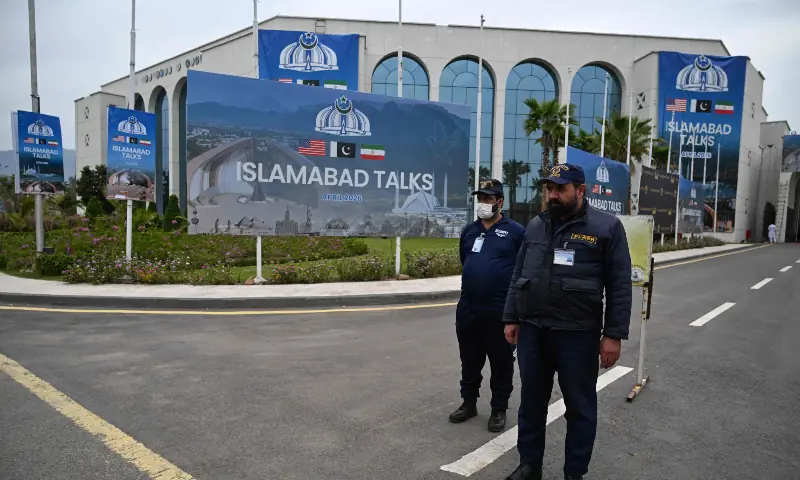
Islamabad Keyed Up for 'Make-or-Break' Talks
Historic US-Iran direct dialogue is set to begin in Islamabad, facilitated by Pakistan's backchannel diplomacy, after a last-minute hurdle over Israeli strikes in Lebanon was partially eased. The talks — the first high-level engagement between Washington and Tehran since 1979 — face deep divisions over nuclear issues, sanctions, and regional conflicts, with cautious expectations for any immediate breakthrough.
1. The Stage Is Set: First Direct US-Iran Talks Since 1979
The long-awaited dialogue between Iran and the United States is set to begin in Islamabad after a last-minute crisis over Israeli strikes in Lebanon nearly derailed the entire process. Tehran had conditioned its participation on a ceasefire in Lebanon, but signs emerged that a partial truce could take hold just ahead of the talks.
Prime Minister Shehbaz Sharif, in a televised address, described the moment as a critical opportunity to move toward peace. He did not mince words about the difficulty ahead:
"make-or-break situation"
He said efforts were now shifting from a temporary pause to pursuing a more durable settlement, acknowledging the process was entering a "difficult phase."
2. Delegations Arrive in Islamabad
The Iranian delegation, led by Parliament Speaker Bagher Ghalibaf and Foreign Minister Abbas Araghchi, touched down in Islamabad early Saturday. They were received by a high-level Pakistani welcome party including Deputy PM and Foreign Minister Ishaq Dar, National Assembly Speaker Ayaz Sadiq, Chief of Defence Forces Field Marshal Asim Munir, and Interior Minister Mohsin Naqvi.
Dar expressed hope that all parties would engage constructively and reiterated Pakistan's commitment to facilitating a lasting and durable solution to the conflict.
The US delegation, headed by Vice President JD Vance, was scheduled to land later Saturday morning. Accompanying Vance were officials from the National Security Council, State Department, and Department of Defence, while advance security and communications teams had already arrived earlier in the day.
These talks represent the first direct high-level engagement between Washington and Tehran since 1979 — a truly historic diplomatic moment. 🕊️
3. The Lebanon Hurdle: A Last-Minute Crisis
The dialogue came dangerously close to collapsing before it even started. Iran insisted it would not join negotiations unless Israeli strikes in Lebanon stopped. Within the first 24 hours of the Iran-US ceasefire, Israel had launched over 100 strikes on Lebanon, causing hundreds of deaths — turning Lebanon into the central fault line of the entire diplomatic process.
Ghalibaf laid out two clear preconditions for Iran's participation: a ceasefire in Lebanon and the release of Iranian assets frozen abroad, estimated at roughly $7 billion. He stated firmly:
"must be fulfilled before negotiations begin"
Intense backchannel contacts ran throughout the day between Islamabad, Tehran, and Washington, also involving other regional and international actors. These efforts yielded partial results — reports indicated Israel held back strikes in Beirut and the Dahieh suburb, meeting a key Iranian demand.
An Iranian official told Dawn:
"We forced a pause in attacks in Beirut and Dahieh by making it a red line in negotiations and also made it clear that if Israel crosses it again, talks would be off."
However, Israeli attacks continued in other parts of South Lebanon, killing at least 23 people. The fundamental disagreement remains: Iran insists any ceasefire must extend across all fronts, including Hezbollah, while the US and Israel have treated Lebanon attacks as outside the scope of the truce — despite an initial understanding that Lebanon would be included.
4. Tough Talk from Washington
Vice President Vance, ahead of his departure from Washington, described the expected talks as potentially "positive" and said the US was prepared to negotiate in good faith. However, he cautioned that Washington would not be "receptive" to what it perceives as stalling tactics.
President Donald Trump struck a notably harder tone, warning that Iran did not have:
"many cards"
He said military action could resume if the talks failed and criticized Tehran over continued restrictions on shipping through the Strait of Hormuz, which remains a key point of leverage in the standoff. ⚠️
5. Pakistan's Central Role
PM Shehbaz, whose country has been instrumental in making these talks happen, expressed Pakistan's deep commitment to the process:
"try its level best"
He thanked both sides for accepting his proposal for a temporary ceasefire and dialogue in Islamabad, framing the negotiations as an opportunity to resolve "contentious issues through dialogue" while acknowledging the immense complexity of the task ahead.
Pakistan's backchannel diplomacy proved crucial in securing the partial pause in Israeli strikes that allowed Iran to proceed with its participation — a significant diplomatic achievement for Islamabad. 🇵🇰
6. The Agenda: Deep Divisions Remain
The talks are based on Iran's 10-point proposal, which Washington accepted as a general framework, but fundamental differences persist between the two sides.
What the US wants:
- Restrictions on Iran's nuclear programme, including limits on enrichment
- Possible removal of nuclear material
What Iran demands:
- Full sanctions relief
- Recognition of its nuclear rights
- A framework for navigation through the Strait of Hormuz
- Access to frozen funds
Additional flashpoints include regional proxy networks, missile ranges, and the thorny question of sequencing concessions — essentially, who gives what first.
7. Cautious Expectations
Officials and analysts widely believe that the sheer breadth of issues makes it unlikely that substantive breakthroughs will emerge within the initial two-day engagement. At best, the opening round may establish a pathway for continued negotiations or yield limited understandings on immediate de-escalation measures.
Expectations therefore remain deliberately cautious. The arrival of both delegations in Islamabad represents a rare and historic diplomatic opening, but the process is unfolding under enormous strain — with ongoing violence in Lebanon, continued disruption in Gulf shipping lanes, and deep mistrust between Washington and Tehran that has built up over more than four decades.
Final Thoughts
The Islamabad talks mark an extraordinary moment in international diplomacy — the first direct high-level contact between the US and Iran since 1979, made possible largely through Pakistan's persistent backchannel efforts. Yet the fragility of the process is undeniable: Lebanon remains a live flashpoint, the agenda is vast and contentious, and both sides carry decades of mistrust to the table. Whether this "make-or-break" moment leads to a genuine diplomatic pathway or collapses under the weight of competing demands will likely shape the trajectory of Middle Eastern geopolitics for years to come.
Need a summary like this?
Get instant summaries with Harvest