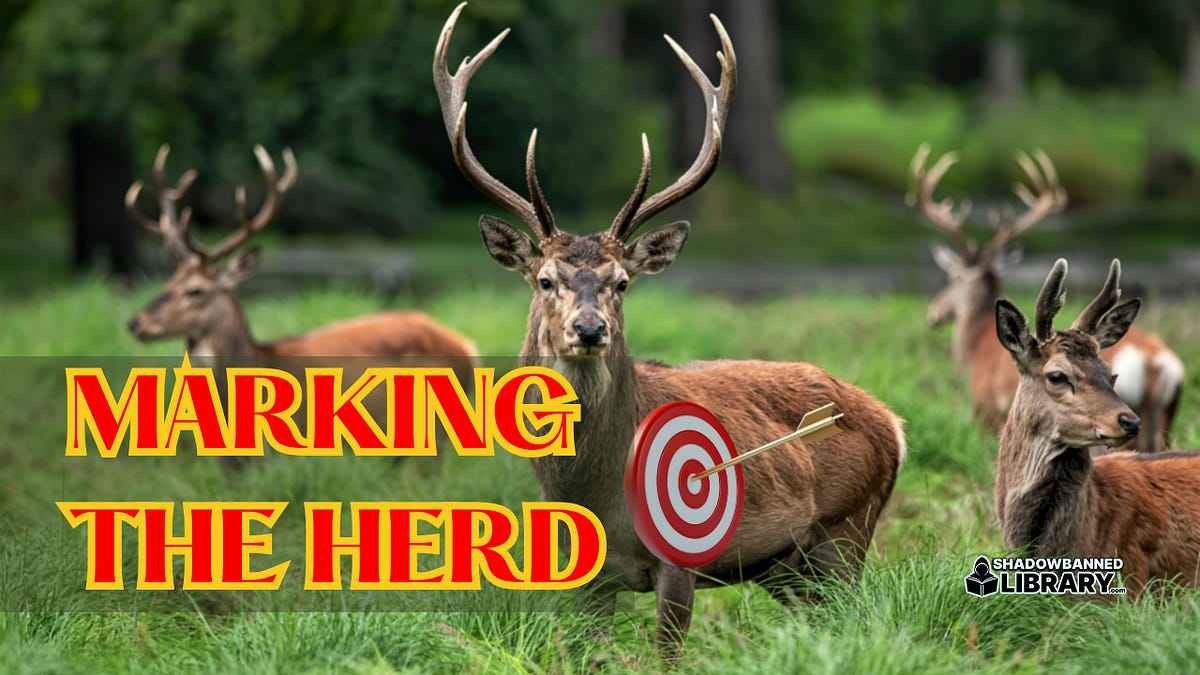
US Vaccine to Sterilize Wildlife
This article argues that wildlife fertility vaccines represent a dangerous form of human interference with nature's self-regulating systems. The author contends that these vaccines, along with tracking chemicals used in wildlife management, parallel concerning practices in human medicine and food systems, suggesting a broader agenda of population control and surveillance.
1. The Wisdom of Observing Nature 🦌
The author opens with a nostalgic reflection on growing up around people who had an almost mystical connection with animals. These were individuals who could read the subtle signs of nature — telling which mare was pregnant by how she shifted her weight, or which cow was about to calve by how she stood apart from the herd. This intuitive knowledge came from direct observation, not from screens or technology.
In those days, when animal populations grew too large, Mother Nature handled it through drought, famine, and lost territory. Birth and fertility naturally declined during periods of stress. Human intervention was reserved only for genuine emergencies — a broken leg or an infection from a coyote trap. The very idea that nature needed "management" would have seemed not just strange but fundamentally wrong to those who understood the importance of thinking about consequences for future generations.
"We can always have short-term gains, but long-term degradation and destruction."
2. Nature's Self-Healing Ability 🌿
The author offers a local example from Northern California to illustrate how ecosystems naturally heal themselves. Eucalyptus and fennel have spread in the region because the soil and ecosystem were disrupted by industrialization. Rather than being invasive problems, these plants are actually repairing the damaged soil. Once the soil returns to its original state, native species can grow again naturally.
Meanwhile, well-intentioned restoration projects at local parks have failed spectacularly — dead plants surrounded by abandoned chicken wire. The author argues this happens because we're interfering with natural processes rather than allowing them to unfold.
The article points to Chernobyl as dramatic evidence of nature's resilience. Despite the catastrophic nuclear disaster of April 26, 1986, the exclusion zone is now thriving with wildlife, including nearly once-extinct animals. The reason? Humans are not there to interfere.
"Apparently, they didn't get the memo about the damage."
The author expresses skepticism about official narratives claiming the animals are damaged at the DNA level, arguing that observable reality shows healthy animals with healthy offspring for multiple generations.
3. The Introduction of Wildlife Fertility Vaccines 💉
This is where the article takes its central turn. The author argues that modern wildlife management has shifted from observation to intervention, and from natural balance to manufactured control.
"Once the idea takes hold that nature cannot be trusted to regulate itself, everything else follows. If populations are framed as unstable, then reproduction becomes a problem to solve."
Wildlife fertility vaccines are marketed as non-lethal, reversible, and compassionate alternatives to culling, trapping, or relocation. Officials justify them by citing overgrazing, traffic accidents, complaints from wealthy residents, and threats of starvation. But the author urges readers to question who decides what "care" looks like and who profits from it.
"Because nature has always known how to thin a herd. How do we know for sure? Because there is no other way."
The author firmly believes there are no mistakes in nature — any soil that hasn't been tilled and factory-farmed remains healthy and nutrient-dense. The idea of soil depletion, they argue, is simply a story created to sell vitamins and supplements.
4. How Wildlife Fertility Vaccines Actually Work 🔬
The article provides a detailed breakdown of how vaccines like GonaCon function at the biological level. The active target is a hormone called GnRH (Gonadotropin-releasing hormone), which controls reproductive hormones in mammals.
The vaccine's components include:
- Synthetic GnRH manufactured using petroleum-based sugars, processed nitrogen and hydrogen gases, and stabilized with sulfur compounds from oil and gas refining
- Blue blood protein from sea snails containing copper from mined ores, which triggers the immune response
- Purified mineral oil derived from crude petroleum
- Plant-based emulsifiers to keep the mixture stable
- Fragments of killed bacteria grown in tanks, acting as immune stimulants
When injected, the animal's immune system produces antibodies against its own reproductive signaling hormone. These antibodies bind to natural GnRH and block it from functioning. Without GnRH signals, the body stops releasing hormones needed for ovulation and sperm production.
"The animal does not collapse. It does not appear sick. It still eats, moves, socializes, and mates. What changes is not behavior on the surface, but the biological future."
The author notes that while these vaccines are described as temporary, they can last years and sometimes become permanent after repeated doses. More importantly, reproduction isn't an isolated process — it shapes herd structure, mating hierarchies, social bonding, territorial behavior, migration timing, and stress patterns.
"This is not just about preventing births. It is about reshaping how a healthy population once existed."
5. Chemical Tracking Through Bones and Teeth 🦴
The article explores how wildlife management programs track animals not through external tags, but through chemistry embedded in the body itself. Tetracycline, used in bait programs supposedly to combat rabies, is chosen specifically because it binds to calcium-rich tissues like bones and teeth.
When an animal consumes tetracycline-laced bait, the compound becomes incorporated into bone and tooth material. Years later, researchers can examine skeletal tissue under ultraviolet light to determine if that animal ingested the bait. The body becomes a permanent record of exposure.
"Bone and teeth are treated as long-term storage media."
6. The Same Logic Applied to Humans 👥
The author draws explicit parallels between wildlife tracking and human medicine, identifying several drug classes that similarly bind to calcium-rich tissues:
Tetracycline-class antibiotics (minocycline, doxycycline, tigecycline, demeclocycline) deposit in teeth and bone during mineralization. Minocycline is particularly known for causing skeletal discoloration, including what's called "black bone disease."
Bisphosphonates (Boniva, Fosamax, Reclast) prescribed primarily to postmenopausal women for osteoporosis bind directly to bone mineral surfaces and can remain in the skeletal system for years or decades. The author argues these drugs are disproportionately prescribed to women not because men don't experience bone loss, but because medical narratives have been constructed to sell these medications.
"Meaning, they found a story to sell women on black box warning drugs to test various track and trace methods."
Children represent another vulnerable category, as drugs binding to calcium during development become permanent parts of the physical structure being formed.
Beyond pharmaceuticals, the author identifies:
- Fluoride in water supplies, which integrates into enamel and bone
- Heavy metals (lead, cadmium, certain forms of strontium) that bioaccumulate in bone for decades
- Antibiotic residues in animal products when withdrawal periods aren't followed
- Vitamin and supplement premixes fed to livestock before slaughter
"Heavy metals such as lead, cadmium, and certain forms of strontium also bioaccumulate in bone... What a strange coincidence. They drop rabies pellets into wildlife to track and trace, and they spray all of us with the bioaccumulating tracking and tracing from the skies."
The author expresses concern about bone broth from vaccinated animals containing tetracycline, and about chemicals passing through meat from animals fed industrial vitamin supplements.
"Certain substances are chosen because they bind to calcium. Because calcium-rich tissues last. In wildlife systems, this allows for verification of ingestion. In human systems, it creates long-term internal records of exposure. In animals, this is called tracking. In humans, it is called treatment, supplementation, or environmental exposure."
7. Wildlife as the Proving Ground 🎯
The author explains why wildlife received such focus in this article — not because animals are the ultimate point, but because they're where these systems are easiest to observe. When systems are tested on animals, it happens quietly, away from cultural scrutiny, framed as benevolent and scientific.
"That makes wildlife the proving ground for the natural progression in their lockstep."
Historical famines are cited as warnings. The Russian famine and Irish potato famine weren't caused by nature but by systems that calculated resources on paper rather than observing reality. Crop quotas were enforced even when villages had nothing left to give.
"People were recorded as profitable or loss resources and as labor units, so starvation was not an accident of this system. It was on purpose, directly caused by it."
The author warns that similar patterns are emerging today, with the response to problems being to change narratives rather than address underlying causes.
8. What Comes Next ⚠️
The article concludes by previewing upcoming work that will follow this logic into human systems, examining:
- How bodies are treated as divisible, usable, and negotiable rather than continuous and whole
- How reproduction becomes something requiring justification
- How tissue, organs, blood, and potential life are reorganized into categories that can be extracted, traded, archived, or discarded
"What I found was not hidden. It was written into policy language, procurement systems, medical protocols, and market structures. It is discussed in fragments, so no one has to look at it as a whole."
The author issues a warning that the upcoming content will be "shocking and horrific" but maintains that knowledge is power.
Final Thoughts 💭
This article presents a deeply skeptical view of modern wildlife management and draws controversial connections to human medicine and food systems. The core argument is that techniques developed to control animal populations — through fertility suppression and chemical tracking — represent a concerning model that may already be applied to humans through pharmaceuticals, food additives, and environmental exposures.
Whether readers agree with the author's conclusions or not, the article raises thought-provoking questions about the relationship between intervention and nature, the unintended consequences of "management," and who ultimately benefits from systems that frame reproduction as a problem requiring technological solutions. The call to observe nature directly, rather than accepting official narratives uncritically, echoes throughout the piece.
Need a summary like this?
Get instant summaries with Harvest