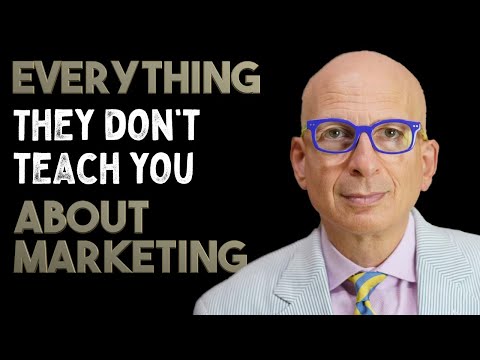
Seth Godin - Everything You (Probably) DON'T Know About Marketing
Brief Summary:
In this interview with Seth Godin, bestselling author of "This Is Marketing," we get a masterclass on what marketing truly is (and isn't). Godin challenges misconceptions—explaining the real difference between brands and logos, why purpose and psychographics matter more than demographics, and how authentic brands make meaningful change. This video is packed with eye-opening lessons and practical wisdom for anyone who wants to understand the heart of modern marketing.
1. Rethinking Brands, Logos, and True Distinction
Seth Godin dives right in by stressing that many companies—and marketers—misunderstand what a brand truly means. He pokes fun at how much people obsess over logos, saying:
"Companies spend way too much time on their logo. Just like people on YouTube spend way too much time on their hair."
He illustrates the difference between having a brand versus having a logo with a memorable analogy:
"If Nike opened a hotel, I think we would be able to guess pretty accurately what it would be like. If Hyatt came out with sneakers, we'd have no clue. Because Hyatt doesn't have a brand—they have a logo."
Godin emphasizes that a real brand is a "promise to people"—it sets expectations and gives people a shortcut for what to expect each time. When that promise is distinct, you've earned something valuable:
"If it's not distinct, let's admit you make a commodity and you're trying to charge just a little bit extra for peace of mind."
He points out the key problem for many big hotel chains: consumers just sort by price because the brands lack meaningful distinction.
"Why would I pay $200 extra to go a block away? I don't. So what's the value of a brand? The value of a brand is: How much extra am I paying above the substitute?"
2. The Essence of Marketing (And Dispelling Myths)
Godin is passionate about shifting the perception of marketing as something manipulative or selfish.
"You have to begin by undoing the marketing of marketing. Marketing is not an insult, it's a compliment because what marketers do is we make change happen."
He explains that effective marketing is about deciding:
- Who are you seeking to change?
- What's it for?
"The first third of the book is: What marketers do is we decide who we are seeking to change—who's it for, and what's it for."
Godin insists that making "average stuff for average people" and just shouting louder is a flawed strategy:
"The truly successful ones are specific. They're not general."
He introduces the powerful concept:
"Culture defeats everything. If you've got culture at your back, what you're doing is easy. If you're trying to change the culture, it's difficult. Culture is: people like us do things like this."
3. Status, Affiliation vs. Dominance, and the Psychology of Decision Making
Godin enriches his marketing worldview by showing how humans make decisions based on status—not just social standing, but group belonging and progression.
"Human beings make decisions based on status—not just having a fancier car, but who's moving up and who is not."
He also explores the contrast of affiliation (being part of something) versus dominance (being on top), noting their influence everywhere in culture and branding.
This leads to a key transition: after understanding these human deep drives, marketers can then choose between brand marketing (long-term, identity-building) and direct marketing (measurable, transactional).
4. Brand Marketing vs. Direct Marketing—What's the Big Difference?
Godin clarifies a major confusion between brand marketing and direct marketing:
"You can't measure a brand. You can measure direct. You must measure direct."
He recounts what he learned from Lester Wunderman (father of direct marketing):
"Direct Marketing is measured marketing. If you can measure it, you're gonna act differently because you can see what happened Tuesday and change what you do on Wednesday."
Brand marketing, on the other hand, is about building perception and identity over time—think logo placement, store location, emotions.
Godin warns against confusing the two:
"If you're an individual and you're counting your Facebook likes or your YouTube views, you're making a big mistake. You're measuring the wrong thing."
Direct marketing can spiral into a race to the bottom, chasing clicks without substance, so he says:
"We need to race to the top. Use direct marketing when we should, and brand marketing the rest of the time."
He sums up the difference with a fun analogy:
"Brand marketing is the tortoise's race. The hare's is direct marketing or advertising."
Brand marketing is slower, steadier, and more valuable in the long run; direct marketing is quick, transactional, and potentially unsustainable.
5. The Nike Case Study—Standing for Something Bold
Godin brings up the Nike and Colin Kaepernick partnership as a prime example of courageous brand marketing:
"Colin Kaepernick is a symbol, he stands for something, and the other sneaker companies have been afraid to stand for what Colin Kaepernick stands for."
Nike's move, while risky given its controversy, was ultimately brilliant:
"With just two words, they were able to say: us, him, we stand for something. When you talk about Nike, you're talking about standing for something."
This wasn't just a calculated stunt—Nike had prepared their audience over decades, cultivating a brand DNA that aligned with bold social statements.
"The kind of person that is decrying this, psychographically, isn't their core audience. Nike is selling to the early adopter of fashion, people who are playing with new ideas in the culture—not people trying to preserve old ideas."
The lesson? Brands that truly know their psychographic audience can make bold moves unapologetically—and the market will reward authenticity.
6. Brands vs. Commodities—Why Most Companies Miss the Mark
Expanding on the earlier brand vs. logo theme, Godin warns about the dangers of becoming a commodity in a saturated market:
"If it's not distinct, let's admit you make a commodity and you're trying to charge just a little bit extra for peace of mind."
He points to new boutique hotel chains that charge more, not because of traditional luxury, but because they create a unique, emotional experience—appealing to people who care about the vibe and social scene, not just the room amenities.
"They're investing not in: 'oh, you get a room with three power outlets.' They're investing in throwing a party in a place where you also can sleep while you're on the road."
The big takeaway: Substance beats slogans. Find the people who care—your "smallest viable group"—and serve them with work that matters.
7. Demographics vs. Psychographics—Why Beliefs Trump Background
Godin highlights a vital shift in modern marketing: moving from demographics (age, income, etc.) to psychographics (attitudes, beliefs, dreams):
"It doesn't matter what your skin color is. It doesn't matter what your income is. It's: what's your narrative inside?"
Thanks to platforms like Facebook and Google, marketers can now target people based on what they believe not just who they are on paper.
"Going forward, the old-school marketer still talks about demographics. They're wasting their time."
This also means that it's okay to exclude audiences who don't fit your values:
"We have to say: it's for you, and it's not for you... I didn't separate you because of who your parents were. I separated you because of what you believe and what you dream of."
8. Empathy, Data, and Finding Your True Audience
Seth insists that empathy is the starting point for real marketing:
"I don't think you have any business being a marketer unless you have empathy for the people you are seeking to serve."
He acknowledges the power—and the danger—of data-driven personalization. Used well, it enhances the customer experience ("Amazon remodels the store for me"), but done poorly, it can be invasive.
"It's not about privacy, it's about being surprised."
To find your audience, he recommends starting with those who already believe what you believe, and then expanding as you understand different needs through observation and curiosity.
"Begin by asserting what a group who believes a thing might want to do. Learn a lot by noticing."
"Focus groups? People don't know what they want. They just know what they dream."
9. Mission-Driven Companies, Authenticity, and "Work That Matters"
Godin stresses that mission-driven or purpose-driven work is not a marketing stunt or an afterthought:
"Too often we get hung up by reverse-engineering our mission. We say, 'I'm making money doing X, so I'll come up with a phrase that will let me keep doing X.' That's not what you're talking about."
He gives credit to brands like TOMS and Warby Parker not because of their "buy one, give one" model, but because of the authentic mission:
"It's not about shoes. It's: how do I get an early adopter of fashionista who wants a story she can tell her friends to buy a product that's going to have a better positive impact on the world?"
Even when it comes to testing new retail ideas, Warby Parker showed smart, low-risk experimentation—using a bus as a roving shop before building brick-and-mortar stores. This is the marriage of direct marketing tactics with a brand mission.
10. The Smallest Viable Audience and Quality Over Quantity
Godin's philosophy is about doing better, not just getting bigger.
"The mindset of, 'oh, I don't have to just show up arrogantly saying I insist.' I can show up and listen and assert. Everyone is not the goal—cannot be the goal."
He emphasizes serving your smallest viable audience—the true fans and core customers who will help your brand thrive, rather than diluting your purpose for mass appeal.
Drawing from personal experience, he notes:
"Don't level up on staff, don't level up on spend. Put all of it into better, not more. Because if you can make better, maybe they'll tell their friends and you can do this work."
Quality and resonance matter more than sheer size—a million shallow fans doesn't beat a thousand true believers.
11. Building Your Brand's Compass and Staying Authentic
Godin asks us to define our own compass—our unique values and mission.
"You need to get clear about who's it for and what's it for. If you are clear, like Howard Schultz was clear—'I need America to drink better coffee'—that's your mission."
He warns against getting caught up in other people's metrics (bestseller lists, followers, etc.) at the expense of your original purpose.
"If you keep compromising so you can have 18 coffee shops that are now pretty sucky... I don't know why you did that."
Stay true to your personal metrics of success and build around your core values.
12. Personal Fulfillment, Scarcity, and the Joy of Craft
In closing, Seth gets personal. He shares that he doesn't chase infinite growth—he values scarcity and depth, doing work for those who genuinely care.
"Infinity has never been my friend. If you're making YouTube videos and get a million visits, you say: why didn't I get two million? But with scarcity, I know I couldn't have gotten any more; I don't have any more. It makes me emotionally more connected to the work."
On his own goals and potential retirement, Godin says he's already living the dream—by teaching, helping people see what they can't unsee, and making the world a little better for the next generation:
"For someone who's lucky enough to be able to do almost anything he wants, this is what I want to do: I want to be a teacher. I want to help turn on lights and help people; not everyone, but some people, see things they can't unsee."
Final Thoughts
In this refreshingly honest and practical conversation, Seth Godin makes it clear: Real marketing is about making a difference for people who care.
Don't obsess over logos and metrics; obsess over serving your smallest viable audience, living your mission, and fostering genuine connection. As Godin puts it:
"We're not victims. We're creators. Help people take responsibility for the change they seek to make."
Whether you're a seasoned marketer or just starting, these timeless lessons challenge and inspire you to create work—and brands—that truly matter. 🚀
Need a summary like this?
Get instant summaries with Harvest