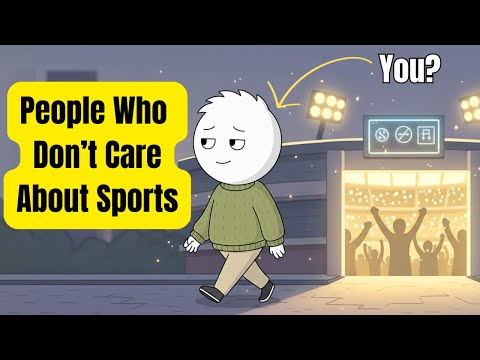
Psychology of People Who Don't Obsess Over Sports
This video explores why a significant portion of the population feels indifferent toward sports, attributing it to differences in brain wiring, tribal instincts, and dopamine regulation. It explains that not being a sports fan is often linked to higher individualism, stable self-esteem, and a preference for seeking meaning through direct engagement rather than vicarious competition.
1. The Biology of Fandom vs. Indifference
While millions of people experience extreme emotional highs and lows based on the performance of professional athletes, a large group of people remains entirely unmoved. This isn't just a matter of "disinterest"; neuroscience suggests that the brains of non-fans may actually be wired differently. 🧠
For sports enthusiasts, watching a game is a deeply tribal experience. Historically, human survival depended on belonging to a group, and sports serve as a modern manifestation of this instinct. When a fan watches their team, their brain releases oxytocin, the "bonding hormone" associated with family and close relationships.
"Their brain literally tricks them into thinking these millionaire athletes are part of their clan."
In contrast, people who don't care about sports often possess lower tribal instincts. They tend to be more individualistic and do not feel a psychological need to belong to a "larger tribe" to feel complete or secure. For these individuals, identity is self-contained rather than tied to a collective group.
2. The Dopamine Loop and Behavioral Addiction
The excitement of sports is largely driven by dopamine, the neurotransmitter responsible for anticipation and reward. Sports provide "constant micro-doses" of dopamine through every play and possession. This is intensified by intermittent reinforcement—the same psychological principle that makes slot machines and gambling so addictive. Because the outcome is uncertain, the brain stays hooked on the "what if."
"The uncertainty is what makes it so powerful... It's the most addictive reward schedule known to psychology."
For those who aren't sports fans, their dopamine systems simply aren't triggered by vicarious competition (watching others compete). Research suggests this might even be genetic; variations in dopamine receptor genes can predict how much value a person places on spectator activities. If you find sports boring, it might literally be written in your DNA. 🧬
3. Self-Esteem and "Basking in Reflected Glory"
Psychologists use the term BIRGing (Basking In Reflected Glory) to describe how fans say "we won" when their team succeeds, linking their personal self-worth to the team's victory. Conversely, they often distance themselves ("they lost") during failure.
People who don't obsess over sports generally have a more stable self-concept. They don't rely on external victories—achieved by people they don't even know—to feel successful or validated.
"They don't need external victories to feel successful. Their self-esteem is more stable, less dependent on things completely outside their control."
4. Empathy Allocation and Openness to Experience
A common misconception is that non-fans lack empathy because they don't "feel" for the players. However, it's more about empathy allocation. Everyone has a limited capacity for emotional investment. While fans give that energy to athletes, non-fans often direct it toward:
- Social causes and community 🌍
- Personal relationships
- Creative projects and art 🎨
- Intellectual challenges
Studies show that people with low sports interest often score higher in Openness to Experience. They seek "transcendence" and emotional highs through music, nature, or ideas rather than the narrative of a ball game.
5. Narrative, Meaning, and Reciprocity
The divide between fans and non-fans often comes down to how they perceive meaning. Fans love the "story"—the underdog, the comeback, the rivalry. Non-fans, however, often view this randomness as meaningless. They struggle to see why they should invest energy into an outcome they cannot control.
There is also a distinction between parasocial investment (a one-sided relationship with a celebrity/athlete) and direct engagement. Non-fans often prefer activities where there is reciprocity, meaning their presence and effort actually change the outcome.
"Non-sports people prefer investing emotional energy where there's actual reciprocity, where their care matters to the outcome, where they're participants, not spectators."
Conclusion: Playing a Different Game
If you aren't interested in sports, you aren't "missing" a fundamental human experience; you are simply calibrated differently. While fans find "flow states" in a stadium, you might find yours in a book, a scientific discovery, or a personal hobby.
"The next time someone asks, 'Did you see the game?' and you genuinely could not care less, remember, you're not broken. You're not boring. You're just playing a different game."
Ultimately, choosing to focus on your own life's "stakes" rather than the struggles of strangers on a TV screen is a valid, and even radical, way to remain present in your own reality. ✨
Need a summary like this?
Get instant summaries with Harvest