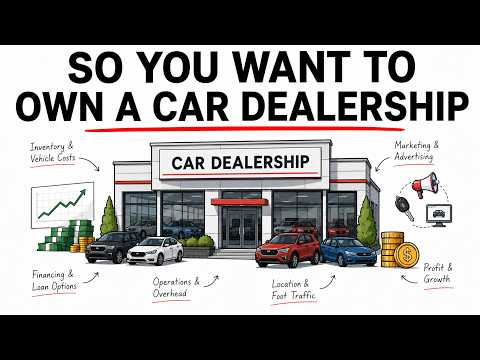
The Economics of Owning a Car Dealership
This deep dive reveals how car dealerships generate immense wealth despite making paper-thin margins of just 1% to 2.5% on actual vehicle sales. By leveraging floor plan financing, high-margin service departments, and complex Finance & Insurance (F&I) strategies, dealership owners transform a highly risky retail business into a compounding financial engine. Through offshore reinsurance companies and real estate leasebacks, successful owners scale their operations to build multi-million-dollar fortunes.
1. The Illusion of the Dealership Business
When you drive past a local car dealership, it's easy to look at the sprawling rows of shiny cars, the massive showroom, and assume the owner is easily raking in cash. On paper, the auto dealership industry is absolutely massive. 🚗
Across the United States, there are roughly 17,000 franchise new car dealers moving more than 16 million vehicles annually. This equates to a staggering $1.3 trillion in total sales. Add in over 276 million repair orders a year, and the service and parts side alone accounts for over $164 billion.
However, these massive numbers hide a very tight reality. Despite moving trillions of dollars, the average dealership keeps only 1% to 2.5% of its revenue as actual profit.
"Sell a car for $10,000. And if everything goes right, the dealership might clear somewhere between $100 and $250 once every single cost is accounted for."
How does an industry with such razor-thin margins produce some of the wealthiest business owners in every town? The answer lies in the business structure, and it has almost nothing to do with selling the actual cars.
2. Choosing Your Path: Three Different Business Models
If you want to enter the car sales industry, you have to choose one of three distinct business paths. Each model functions as a completely different business, despite sharing the same basic storefront:
- Mainstream Franchise (e.g., Ford, Toyota, Chevrolet): This model runs entirely on volume. While margins per car are incredibly low, you gain the advantage of massive manufacturer support, national advertising campaigns, brand recognition, and subsidized financing options. The catch? You are heavily controlled by the manufacturer, who mandates everything from showroom renovations to inventory allocations.
- Luxury Franchise (e.g., BMW, Mercedes-Benz, Porsche): Here, the volume is lower, but the profit margins per vehicle are much higher. Wealthy buyers are less affected by economic downturns, allowing the luxury sector to experience steady growth. However, building and maintaining a luxury showroom is extremely expensive due to strict manufacturer compliance standards.
- Independent Used Car Lot: This is the cheapest and least restrictive entry point. You have no manufacturer oversight, no forced renovations, and you source inventory directly through trade-ins or wholesale auctions. However, independent lots lack a highly profitable warranty repair department, face higher inventory financing rates, and make an average of $1,500 profit per vehicle, compared to $2,000 for franchise dealers.
3. The Staggering Cost of Entry
Opening a standard franchise dealership is not a casual business venture. It requires an upfront investment of $5 million to over $10 million just to open the doors. 💸
First, you must pay the franchise fee directly to the manufacturer. For a mainstream brand like Ford, this might be around $30,000, but for a premium import brand, it easily surpasses $500,000. Next is the physical footprint. A dealership needs 4 to 8 acres of land to house the showroom, service bays, and vehicle inventory.
Building costs vary drastically based on design:
- A basic, pre-engineered metal structure costs $120 to $150 per square foot.
- A concrete tilt-up build (frequently mandated by luxury brands) costs $250 to $450 per square foot.
Manufacturers also require proof of financial stability before partnering with you. Most mainstream brands demand $500,000 to $1 million in pure liquid capital sitting untouched in your bank account, alongside a total net worth between $2 million and $4 million. Add in another $100,000 for licensing, legal fees, and state bonding, plus $75,000 to $250,000 for Dealer Management System (DMS) software, and you've spent millions before buying a single car.
4. The Squeeze of Inventory and Floor Plan Financing
Managing new car inventory is highly political. Manufacturers distribute vehicles through a system called "turn and earn"—the faster a dealer sells their inventory, the more high-demand cars they are allocated in the next cycle. Slow-selling dealers are penalized with less desirable vehicles. Manufacturers also hold back 10% to 15% of total production to reward top performers or pressure dealers into costly facility upgrades.
Used cars are sourced from trade-ins, lease returns, and fast-paced wholesale auctions (like Manheim or Adesa). Bidding on these auction cars happens in under a minute, and the final price is quickly inflated by buyer premiums ($100 to $500) and transport fees (which can reach $2,200). Ultimately, auction cars usually net a modest 5% to 6% margin.
Dealerships almost never buy their inventory with cash. Instead, they rely on floor plan financing. 🏦
Under a floor plan agreement, a bank or manufacturer-affiliated lender fronts 95% to 100% of the cost for new vehicles (and 75% to 90% for used ones). The lender holds the financial risk, and the loan is paid off the moment the car is sold. However, holding inventory is a massive liability:
"Far plan [Floor plan] interest is typically priced at the benchmark lending rate plus somewhere between 2 and 4 percentage points... industry estimates put the daily holding cost of a single vehicle somewhere between $40 and $85 per car per day."
If a dealership has 100 cars sitting on its lot, and a slow month delays sales by just 10 days, that is an extra $40,000 to $85,000 lost to holding costs. Furthermore, floor plan agreements include curtailment clauses. If a car remains unsold for 90 to 120 days, the lender forces the dealer to make principal payments out of pocket, often forcing them to sell the vehicle at a loss.
To offset this, large dealer groups use the LIFO (Last In, First Out) accounting method. LIFO assumes that the newest, most expensive vehicles are sold first. This paper adjustment inflates the cost of goods sold, shrinks reported taxable profits, and acts as a massive interest-free tax deferral.
5. The Real Profit Engine: Finance & Insurance (F&I)
Because the internet has made car pricing highly transparent, profit margins on the physical car (front-end margins) have shrunk dramatically, averaging around $2,247 for a new car.
The real financial heavy-lifting happens in the Finance & Insurance (F&I) office—the final room where customers complete their paperwork. This single room generates nearly 37% of a dealership's entire gross profit through three main tools:
- Dealer Reserve: When a customer finances a car, the bank offers the dealership a wholesale interest rate (the buy rate). The dealer is legally permitted to mark up this rate before showing it to the customer. If the bank's buy rate is 5% and the dealer marks it up to 7%, the dealership pockets the interest rate spread as pure profit.
- Extended Warranties & Gap Insurance: Officially known as Vehicle Service Contracts (VSCs), these packages carry incredibly high markups. A warranty that costs the dealer $1,000 wholesale is routinely sold to customers for $2,500 to $3,500 (a 150% to 200% markup). Strong F&I departments manage to attach these warranties to up to 84% of all vehicle sales.
- Offshore Reinsurance Companies: Savvy dealer owners don't just take a one-time commission on warranty sales. They establish their own captive reinsurance companies in tax havens like Turks and Caicos or Nevis.
"When you buy that warranty, the premium doesn't just vanish into the manufacturer's pocket. It gets routed into the dealer's own captive insurance company. If your car never breaks down... the dealer keeps the entire underwriting profit."
Under specific tax codes, these underwriting profits can be exempt from standard taxes up to millions of dollars annually. The cash reserves in these offshore entities are then reinvested into compounding stocks and bonds, completely separated from the showroom floor.
6. The Ultimate Cash Machine: Fixed Operations
While the service, parts, and collision departments (known as fixed operations) make up only 10% to 15% of a dealership's total revenue, they generate roughly half of the dealership's entire gross profit. This is because labor and parts boast incredible margins of 45% to 50%. 🔧
Total Dealership Revenue vs. Gross Profit Contribution
┌────────────────────────────────────────────────────────┐
│ Total Revenue:                                         │
│ [▒▒▒▒] Fixed Operations (10-15%)                        │
│ [████████████████████████████████] Car Sales (85-90%)   │
└────────────────────────────────────────────────────────┘
┌────────────────────────────────────────────────────────┐
│ Gross Profit Contribution:                             │
│ [▒▒▒▒▒▒▒▒▒▒▒▒▒▒▒▒▒▒▒▒] Fixed Operations (~50%)          │
│ [████████████████████] Car Sales & F&I (~50%)          │
└────────────────────────────────────────────────────────┘
Car sales rise and fall based on interest rates and consumer confidence, but vehicle maintenance is non-negotiable. Fixed operations provide a reliable, recession-proof cushion for the business. Dealership owners measure this stability using the service absorption rate, which tracks what percentage of the dealership's fixed overhead (rent, utilities, administrative salaries) is paid for entirely by parts and service profits.
The industry benchmark is a 115% absorption rate. Once a dealership exceeds 100%, the service department covers every single operating cost of the physical building. At that point, every car sold in the showroom is pure, unencumbered profit.
Behind the scenes, service technicians are paid using a flat-rate labor system. Instead of earning an hourly wage, technicians are paid a set number of hours per job, regardless of how long it takes them to complete.
- If a brake job is booked at 3 hours, a skilled technician who finishes it in 1 hour still earns 3 hours of pay.
- This allows top technicians to bill 60 to 70 hours of labor in a standard 40-hour work week, while eliminating the financial risk of slow mechanics for the owner.
7. Overhead, Packs, and Secret Manufacturer Back-channels
Operating a dealership involves keeping up with heavy overhead and intricate commission structures. Sales staff typically work on a 20% to 30% commission of the front-end profit. However, dealerships protect their own bottom line through a mechanism called the "pack".
The pack is an arbitrary fee (usually $500 to $800) subtracted from the car's profit before the salesperson's commission is calculated. If a car yields $2,000 in gross profit and has a $600 pack applied, the salesperson's commission is only calculated from the remaining $1,400. If a deal is too slim to generate any meaningful commission, the salesperson receives a flat minimum payout called a "mini" (typically $100 to $250).
Dealerships also pay high monthly fees for legacy DMS software, which can cost $3,500 to $9,500 per month, plus yearly integration fees exceeding $32,000.
To maintain profitability during negotiations, dealers leverage a hidden manufacturer refund called the dealer holdback. 🤫
When negotiating, customers try to push the price down to the "invoice price," thinking it represents the dealer's actual cost. However, the manufacturer intentionally inflates the invoice price by 1% to 3% of the vehicle's MSRP. Once the car is sold, the manufacturer quietly refunds this percentage back to the dealer.
"Picture a $50,000 car with a 3% holdback. The dealer can sell that car at exact invoice price, look you dead in the eye, and still walk away with $1,500 in guaranteed profit you never saw on any piece of paper."
8. Negotiation Games and Relentless Risks
To maximize profit during a sale, dealerships utilize specific pricing strategies and negotiation frameworks:
- Documentation Fees: Supposedly covering paperwork, these fees vary wildly by state regulation. In California, the "doc fee" is capped at $85, whereas in deregulated Florida, the average fee exceeds $1,100 for the exact same paperwork.
- The Four Square Method: This negotiation tool splits the deal into four quadrants: Trade-In Value, Purchase Price, Down Payment, and Monthly Payment. Because most customers focus entirely on the monthly payment, salespeople can easily stretch a loan term from 60 to 72 or 84 months. This keeps the monthly payment low while quietly increasing the total interest and protecting the dealer's margin.
       The Four Square Negotiation Sheet
┌─────────────────────────┬─────────────────────────┐
│     Trade-In Value      │     Purchase Price      │
│                         │                         │
├─────────────────────────┼─────────────────────────┤
│      Down Payment       │     Monthly Payment     │
│                         │   (Customer's Focus)    │
└─────────────────────────┴─────────────────────────┘
Owning a dealership also brings significant financial, corporate, and regulatory risks:
- Interest Rate Fluctuations: High rates raise the cost of holding floor plan inventory while simultaneously dampening consumer demand.
- Manufacturer Mandates: In 2022, Ford required its dealers to invest $500,000 to $1.2 million in electric vehicle fast chargers and specialized training to keep selling EVs. After major dealer pushback, lawsuits, and slowing EV demand, Ford canceled the mandate in 2024, leaving early-investing dealers to absorb the loss.
- Compliance Penalties: Dealers must navigate strict used car warranty disclosures, cybersecurity regulations protecting customer financial data, and lending laws. A single non-compliant finance charge or discriminatory rate markup can trigger six-figure regulatory fines.
9. How Dealership Owners Build Multi-Million-Dollar Fortunes
To mitigate these risks and maximize profits, experienced owners transition from owning a single store to operating multi-store dealer groups. 🏢
By scaling across multiple locations, owners can centralize accounting, human resources, and customer service departments. This scale allows them to negotiate lower software fees, diversify risk across different automotive brands, and significantly expand their captive reinsurance pools to generate massive investment returns.
To understand the full scope of a dealer owner's wealth, look at how their income is structured:
- Official Salary: The average dealer owner draws a standard salary of $112,000 to $177,000 per year.
- Business Distributions: They receive direct profit payouts from the dealership's 2% to 2.5% net profit margins.
- Real Estate Rent: Owners typically buy the physical land under their dealership using a separate real estate holding company. They then lease the property back to their own dealership at high, premium rental rates.
- Reinsurance Dividends: They collect untaxed, compounding investment dividends directly from their offshore captive reinsurance companies.
When these distinct layers of income stack together, a single successful dealership owner easily pulls in high six-figure compensation. For those operating scaled, multi-store networks, total annual earnings comfortably reach into the millions of dollars.
Conclusion
Owning a car dealership is not a passive investment. It requires millions of dollars in highly leveraged debt, constant navigating of shifting manufacturer demands, and strict regulatory compliance. However, for those who master this complex model, it remains one of the most resilient structures in retail.
When vehicle sales decline, the service bays keep the business afloat. When front-end sales margins are squeezed, F&I products and dealer holdbacks quietly bridge the gap. Ultimately, the car displayed in the showroom isn't the primary product—it is simply the gateway into a highly optimized cash-generating machine.
Need a summary like this?
Get instant summaries with Harvest